
Roof Insurance Claims in Aurora, IL
Most roofing websites in Illinois have a page like this and most of them say the same thing: we are insurance claim experts, we will handle everything, we will fight the insurance company for you. A meaningful amount of that sentence describes activity Illinois does not permit a roofing contractor to perform.
So here is the honest version, including the parts that are less flattering to us.
What a Roofer May Legally Do in Illinois
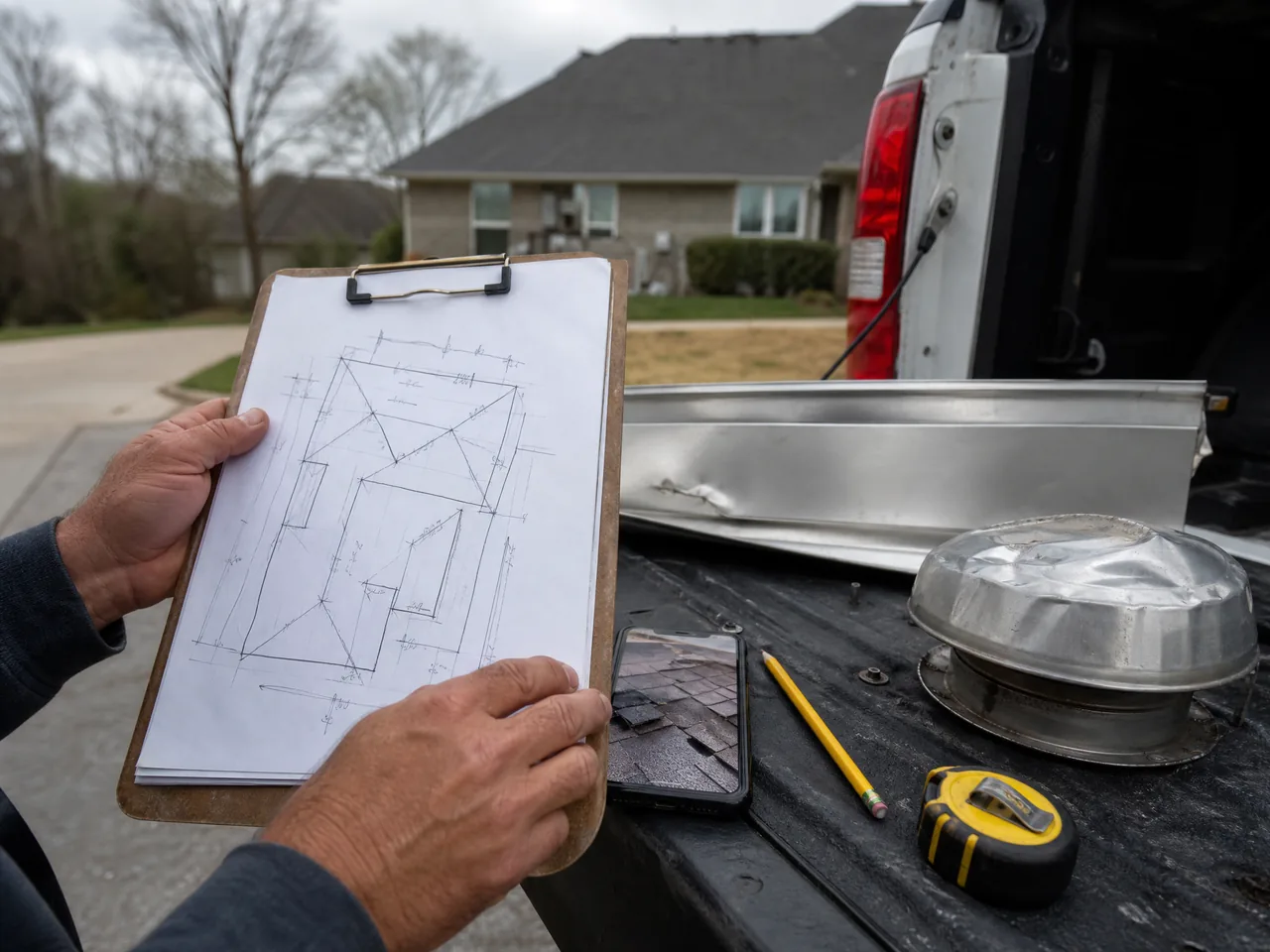
Document the damage. Photograph it with scale references, measure the roof properly, identify each damaged component and what it will take to put right, and write that up in a format an adjuster can work from.
Meet your adjuster on the roof. This is the single most useful thing a contractor does in a claim, and it costs nothing: two people looking at the same slope at the same time reach agreement far more often than two reports written a fortnight apart.
Submit supplements. When the initial scope misses something, drip edge, ice and water shield required by Aurora code, a second layer nobody accounted for, ridge vent, we document it and submit it with evidence. This is normal and carriers expect it.
Build the roof to code once the claim settles, and show you exactly which line items the settlement covered and which it did not.
What a Roofer May Not Do
Negotiate your claim. Adjusting a claim on behalf of a policyholder, interpreting your policy for you, arguing coverage or settlement value with the carrier, all of that is public adjusting. It is licensed separately in Illinois under Article XLV of the Illinois Insurance Code and it is reserved to licensed public adjusters and to attorneys. A roofing contractor doing it is acting without a licence.
This is why "we will handle the insurance company for you" should make you pause rather than relax. The contractor is either describing something they are not allowed to do, or they are describing documentation work in language designed to sound like more than it is.
Touch your deductible. Public Act 96-1113 bars a roofer from paying, waiving, rebating, crediting or absorbing a homeowner's deductible on insurance-funded roofing work. And the usual mechanism for hiding it, inflating the claim by the deductible amount so the settlement covers the whole job, is insurance fraud under 215 ILCS 5/155.51. Both parties are exposed, not just the contractor.
The other version of the same trick is quieter: the contractor does not inflate anything, they just do the work for less than the settlement and pocket the difference as your "waived" deductible. Which means cheaper materials, a shortened ice and water shield run, or a crew doing it faster than it should be done. You paid nothing and you got exactly that.
If You Do Want Someone Negotiating For You
Hire a licensed public adjuster. They are a real profession, they are licensed by the Illinois Department of Insurance, and on a large or contested claim they can be worth their percentage. They typically work on a fee of the settlement, so the arithmetic makes sense on big claims and much less sense on small ones.
We do not take referral fees from public adjusters and we do not have one we push people toward, because that arrangement is precisely the thing that makes the whole area murky. Look one up through the Department of Insurance and check their licence the same way you would check ours.
The Practical Sequence, Start to Finish
- Get an independent inspection and written documentation before you file. If the damage will not clear your deductible, filing achieves nothing.
- File with your carrier, with your photographs and the date of the weather event.
- The adjuster schedules an inspection. Ask us to be there. Same roof, same time.
- You receive a scope and a settlement, usually in two parts: actual cash value now, recoverable depreciation after the work is done and invoiced.
- Missing items get supplemented with documentation.
- Work happens, we invoice, you send the invoice to the carrier and the recoverable depreciation releases.
- You pay your deductible. All of it. That is what it is for.
Will filing a roof claim put my premium up?
Possibly, and weather claims are treated differently from liability claims by most carriers, but nobody honest can promise you it will not. What is more predictable is the effect of multiple claims in a short window, which is what actually moves people into non-renewal territory in Illinois. If the damage is marginal and the repair is near your deductible, paying out of pocket is often the better long game.
My claim was denied. What now?
Request a reinspection with your own documentation attached, which is a normal process rather than a confrontation. If the disagreement is about coverage rather than about what is physically on the roof, that is the point at which a licensed public adjuster or an attorney becomes the right call, not a roofer. We can supply the physical evidence for either.
What is recoverable depreciation and why is my cheque short?
Your first cheque is the actual cash value: replacement cost minus depreciation for the age of the roof. The rest, the recoverable depreciation, releases once the work is complete and invoiced, which is the carrier making sure the money goes on the roof. It catches people out badly, because the first cheque looks like the whole settlement and it is often barely half.
Adjuster booked? Get us on the roof at the same time. It costs nothing and it settles most disagreements before they start.
Get My Free Roof Estimate or call (630) 597-1921
Free written estimate · A person calls you back, not a robot · Licensed & insured, verify us before you sign
Questions We Get About This
Do you charge for meeting the adjuster?
No. It is in our interest as much as yours to have the scope agreed on the roof rather than argued afterwards.
Can I choose my own contractor or does the insurer pick?
You choose. Carriers maintain preferred vendor programmes and will often suggest one, and you are not obliged to use them. Worth thinking about whose interests a contractor on a carrier's panel is balancing.
Should I sign a contingency agreement?
Read it very carefully first, ideally not on your doorstep. Many are binding contracts that lock you to a contractor before you know the settlement, sometimes with a cancellation penalty. We do not use them. We quote the work and you decide.
What if the settlement doesn't cover a code-required item?
That is exactly what supplements are for. Aurora's ice and water shield requirement and its ventilation rules are code, so they are legitimately part of restoring the roof to a compliant condition, and they get missed on initial scopes constantly.
Available Across the Fox Valley
Claim work runs across the whole service area, and after a regional event it is most of what we do for a month.
| Insurance Claim Roofing in Oswego | Montgomery Storm Claim Documentation |
| Roof Claim Support in Naperville | Plainfield Hail Claim Roofing |
| North Aurora Insurance Roof Repair | Sugar Grove Storm Claims |