
Roof and Attic Ventilation in Aurora, IL
This is the page nobody else in this market writes, and it is the one that saves people the most money. Aurora requires a completed ventilation sheet with every roofing permit, and the reason is not bureaucratic: the city's own handout lists what happens when it is wrong, and it is a list of expensive problems.
Half the leak calls we take in January are ventilation problems wearing a roofing costume.
The Maths Aurora Actually Uses
It is three steps and you can do it yourself in about two minutes.
- Attic area = attic length × attic width. Multiple attic spaces connected without fire separation get calculated separately and added together.
- Required net free vent area = attic area ÷ 300, giving you a figure in square feet.
- Convert to square inches = that figure × 144.
Then the split. Aurora wants exhaust at 40 to 50 percent of that total and intake at 50 to 60 percent. Intake slightly exceeding exhaust is deliberate: a positively pressured attic pushes air out through the ridge rather than pulling conditioned air up out of your house.
| Step | Calculation | Result |
|---|---|---|
| Attic area | 50 ft × 30 ft | 1,500 sq ft |
| Required NFVA | 1,500 ÷ 300 | 5 sq ft |
| In square inches | 5 × 144 | 720 sq in |
| Exhaust (40–50%) | 720 × 0.4–0.5 | 288–360 sq in |
| Intake (50–60%) | 720 × 0.5–0.6 | 360–432 sq in |
Separate attic spaces need separate vent sheets. An attached garage attic needs its own sheet if the space is conditioned. A detached garage does not, unless it is conditioned.
What Aurora Says Goes Wrong Without It
Straight from the city's own roofing handout, this is the published list of what unbalanced ventilation causes: mould in the attic, ice dams, moisture build-up, rust, uncomfortable indoor temperature, snow blown into the attic, and damage to the roofing materials themselves.
That last one is the expensive one and it is invisible. A roof over a hot attic cooks the asphalt from underneath. A twenty-five year architectural shingle over an unvented attic is an eighteen year shingle, and the manufacturer's warranty will not cover it because inadequate ventilation is an installation condition rather than a product defect. You paid for twenty-five years and the paperwork says you got what you deserved.
The Failure We Find Most Often
A ridge vent with nothing feeding it.
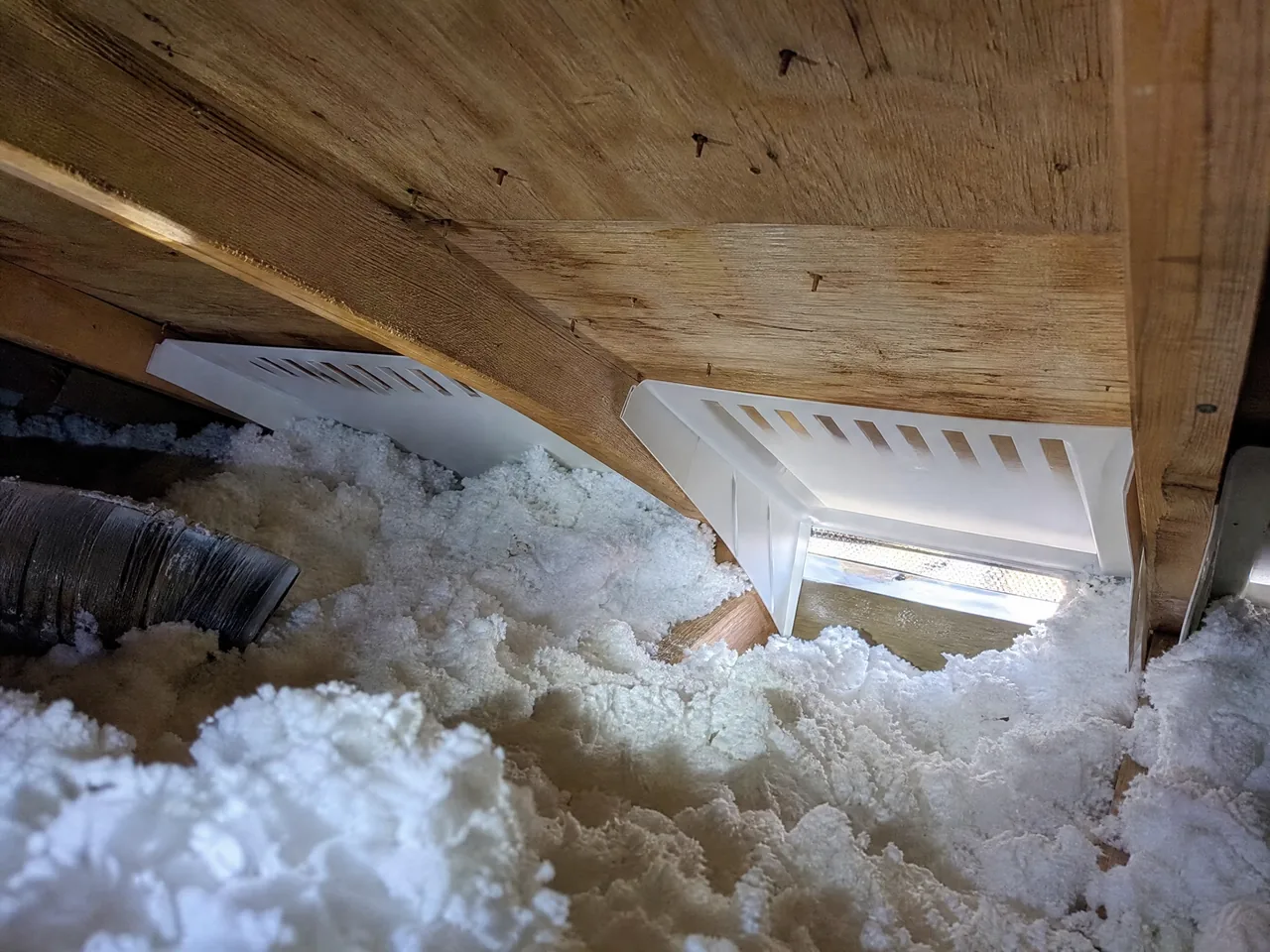
Somebody re-roofed, fitted a nice continuous ridge vent, ticked the exhaust box, and never looked at the intake. Meanwhile the soffit is either solid panel, or vented panel with blown-in insulation packed tight against it from the attic side, or vented panel that was painted over at some point. Exhaust with no intake does not move air; it just pulls conditioned air up out of your living space through every ceiling penetration, which costs you money on the heating bill as well.
The fix is usually baffles at every rafter bay to hold the insulation back off the soffit, plus opening up or replacing the soffit venting itself. It is not expensive and it is far and away the highest-return roofing work we do.
Second most common: mixing exhaust types. A ridge vent and gable vents on the same attic, or a ridge vent plus a powered fan. Instead of drawing from the soffits, the ridge vent pulls from the nearest gable vent and short-circuits the whole attic. If you have gable vents and are getting a ridge vent, the gables usually need closing, or the gable vents need to sit at least three feet below the ridge to count as intake, which is the exception Aurora's own guidance allows for.
Vent Types, and Which Ones Actually Work Here
Ridge vent, continuous, along the peak. Best exhaust for most roofs because it draws along the whole ridge line rather than a point. Wants a proper baffle on the exterior to stop wind-driven snow, which matters in Illinois more than it does in Tennessee.
Soffit and eave vents, your intake. Continuous vented soffit, or individual vents. Aurora's guidance counts vented panel by ratio, one in every three, four or five panels vented, or all panels vented, and the ratio changes the NFVA credit substantially.
Gable vents can act as intake if installed at least three feet below the ridge. On their own, as the only ventilation, they are weak, because they only work when wind blows across them.
Box and turtle vents, fine as exhaust where a continuous ridge is not possible, on a hip roof with very little ridge for instance.
Powered attic fans: we generally advise against them. They can depressurise the attic enough to pull conditioned air from the house, they use electricity, they fail, and in a cold climate they can pull moist air up into the attic in winter. A properly balanced passive system does the job with no moving parts.
Why does the city care about my soffit vents if I am only replacing the roof?
Because a re-roof is the moment the whole assembly has to comply, not just the layer you are touching. Aurora's permit FAQ puts it directly: any time a change is made, the completed work must comply with code, so the existing ventilation has to be shown to meet current requirements. It feels like paperwork until the February you do not get an ice dam.
Will fixing ventilation stop my ice dams?
Usually, yes, and it is the actual fix rather than a treatment. Ice dams form when heat escaping into the attic melts snow on the upper roof, the water runs down to the cold overhang and refreezes into a ridge, then subsequent meltwater backs up behind it and under the shingles. Keep the attic cold and the snow does not melt in the first place. Ventilation plus air-sealing the ceiling penetrations addresses the cause. Heat cables address the symptom and cost money every winter forever. See ice dam removal.
How much does it cost to fix attic ventilation?
Usually $600 to $2,200 as standalone work, depending on how much soffit needs opening up and how many rafter bays need baffles. Done as part of a re-roof it is a fraction of that, because the roof is already open and the crew is already there. If you are replacing your roof anyway, this is the single best money on the estimate and it is also the line item most commonly missing from cheap quotes.
Get ice dams every winter, or an upstairs that is ten degrees hotter in July? Have the attic looked at, not just the roof.
Get My Free Roof Estimate or call (630) 597-1921
Free written estimate · A person calls you back, not a robot · Licensed & insured, verify us before you sign
Questions We Get About This
How do I know if my attic is badly vented?
Go up there on a hot afternoon. If it is dramatically hotter than outside, the exhaust is not working. In winter, look for frost on the underside of the sheathing or damp insulation, which means moist air is getting up there and not getting out. Ice dams every year is the third tell.
Can you have too much ventilation?
You can have it badly balanced, which is the real problem, and too much exhaust relative to intake is worse than less of both. Excess intake is harmless.
Do bathroom fans vent into the attic?
They should not, and an unreasonable number do. It is one of the first things we check, because a bath fan dumping humid air into an attic causes mould and frost that gets blamed on the roof.
Does insulation matter as much as ventilation?
More, in some ways. Ventilation removes heat that gets into the attic; insulation and air-sealing stop it getting there. Do both. Air-sealing the ceiling penetrations, around light fittings and the attic hatch, is cheap and makes the biggest single difference.
Available Across the Fox Valley
Ventilation work follows the 1980s and 1990s subdivisions, where ridge vents went on without anyone checking the intake. That is a lot of houses in these towns.
| Attic Ventilation in Oswego | Montgomery Roof Ventilation |
| Ridge Vent Installation in Plainfield | Yorkville Attic Ventilation |
| North Aurora Soffit Intake Repairs | Roof Ventilation for Bolingbrook Homes |