
Roofing in Bolingbrook, IL
Bolingbrook is around seventy-three thousand people in Will County, built dense and built fast, mostly between the late 1960s and the 1990s. It is the eastern edge of where we work and it has the most uniform housing stock of any town on our list.
Dense, Uniform and Mostly on Its Third Roof
Bolingbrook grew from a few hundred people to a substantial suburb in about two decades, and the subdivisions off Boughton Road, Briarcliff and Old Chicago Road went up in large uniform tranches. Split-levels, bi-levels, tri-levels and modest two-storeys, close together, on small lots.
Roofs of that era are typically on their second or third covering by now, which makes the layer count the first thing to establish. Two layers means everything comes off, and a quote that is dramatically cheaper than the others on a Bolingbrook house is very often a layover quote on a house that cannot legally take one.
The dense lot spacing is its own practical factor. On a lot of these streets there is not room to put an Equipter where you would like it, and the neighbour's property line is six feet from your gutter. We plan the debris route before the day rather than working it out with a crew standing there, and we speak to the neighbour where the access genuinely requires it. It sounds trivial and it is the difference between a clean job and a complaint.
Bi-Levels, Tri-Levels and the Roof-to-Wall Problem
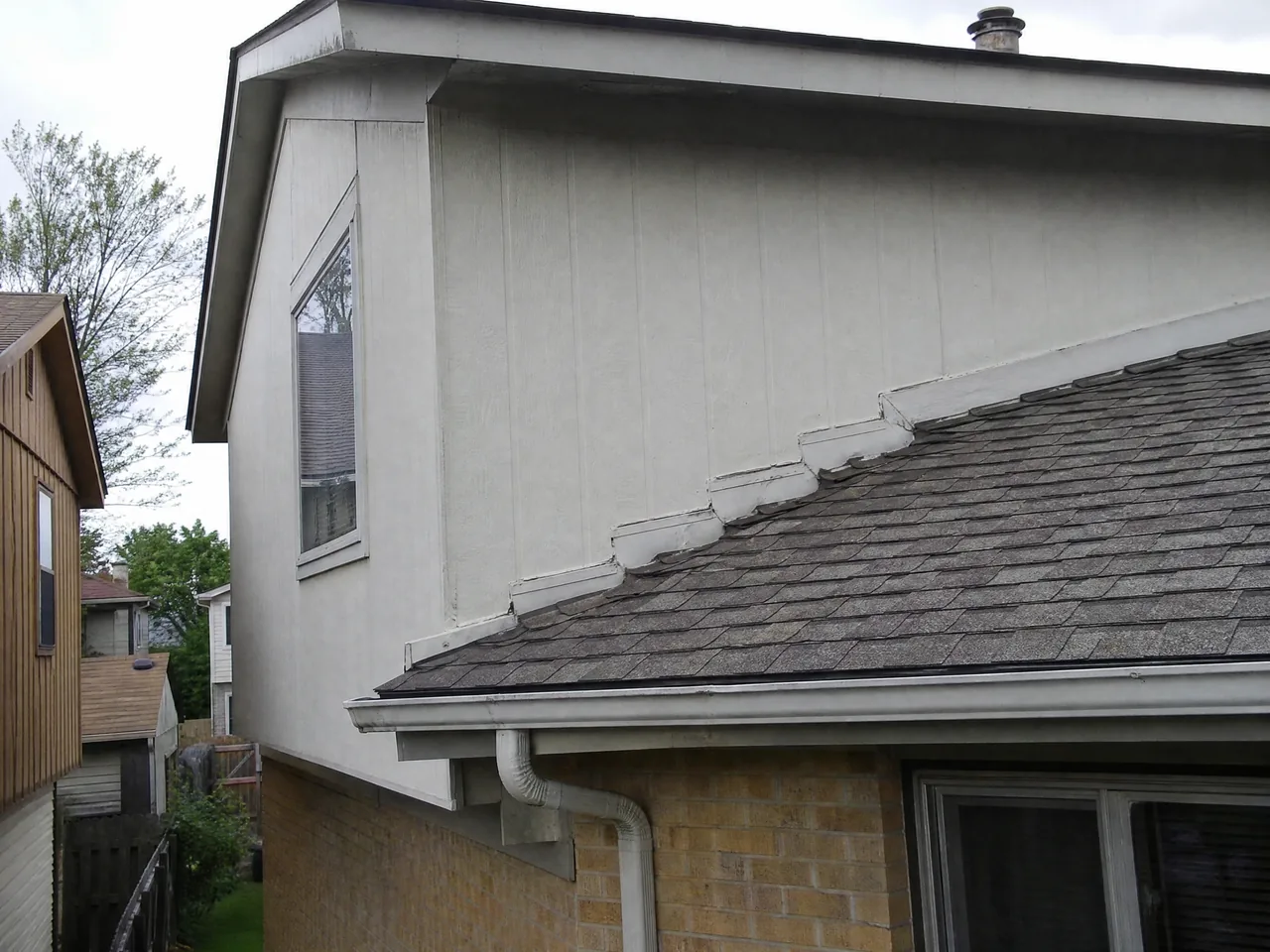
Split-level and tri-level houses have a signature failure and Bolingbrook is full of them: the point where an upper roof section meets a lower one's wall.
That junction needs step flashing woven course by course up the wall, tucked behind the siding, with a kickout flashing at the bottom to throw water out into the gutter rather than down behind the wall cladding. The kickout is the piece that is missing on an enormous number of houses of this era, because it was not standard practice when they were built and it is not visible once the siding is on.
Missing kickout means water runs down inside the wall every time it rains hard. The homeowner sees staining low down on an interior wall, or nothing at all for fifteen years and then rot. If you have a stain that appears on a wall rather than a ceiling, on a split-level, this is the first thing to check.
Storm Work and the I-55 Corridor
Bolingbrook sits in the same severe weather corridor as the rest of this area and the August 2025 line crossed it. Around 27 confirmed severe weather events since June 2024 across the wider region.
Being a large, dense town with newer-than-Chicago housing, Bolingbrook also gets door-knocked heavily after any hail event. The standing advice applies with force here: get your own inspection, look the contractor's Illinois roofing licence up on the public register, and do not sign anything on your doorstep. Illinois leads the country in hail damage fraud and the arrests under Operation Hail were in this state, not somewhere else.
On the commercial side, the I-55 corridor and the distribution and retail around Promenade Bolingbrook is single-ply membrane territory, which is covered on the commercial roofing page.
Stain appearing on a wall rather than a ceiling? On a split-level that is usually a missing kickout flashing, and it is fixable.
Get My Free Roof Estimate or call (630) 597-1921
Free written estimate · A person calls you back, not a robot · Licensed & insured, verify us before you sign
What We Do in Bolingbrook
Full range in Bolingbrook. It is the eastern edge of our area so scheduled work sometimes runs a few days behind, though we get there.
Bolingbrook Roofing Questions
Do you come out to Bolingbrook?
Yes, though it is our eastern edge, so scheduled work here can run a few days behind the Fox Valley towns. Emergencies we still respond to.
What is a kickout flashing and do I need one?
It is a small piece of flashing at the bottom of a roof-to-wall junction that throws water out into the gutter instead of letting it run down behind the siding. If you have a split-level or tri-level of Bolingbrook's typical era, there is a decent chance it is missing, and it is one of the most common causes of hidden wall rot we find.
My roof has two layers already. What are my options?
One: a full tear-off. That is not a preference, it is what the code requires once two layers are up there, and it is also the only way anybody can see what condition the decking is in.