TPO, EPDM and Rubber Roofing in Aurora, IL
Single-ply membrane is what goes on a roof too flat for shingles. There are three serious options in this climate plus a coating category, and the right answer depends on your deck, your drainage, your budget and whether anyone is going to be walking around up there.
EPDM: The Black Rubber One
Synthetic rubber sheet, usually black, in wide rolls with seams either taped or glued. EPDM has been on North American roofs since the 1960s, which is the strongest thing you can say about any roofing product: we know exactly how it ages.
Good: cheapest of the three, extremely forgiving of an imperfect substrate, repairs are simple and cheap, handles freeze-thaw cycling superbly, twenty to thirty years realistic.
Less good: black absorbs heat, so it runs hot in summer and adds cooling load on a conditioned space beneath. White EPDM exists and costs more. Also, glued seams on older installs are the failure point, which is why taped and welded systems have taken over.
Where we use it: residential additions, garages, porch roofs, small commercial. If a homeowner in Warrenville asks for the sensible cheap option on a sunroom, this is it.
TPO: The White One Everybody Is Installing Now
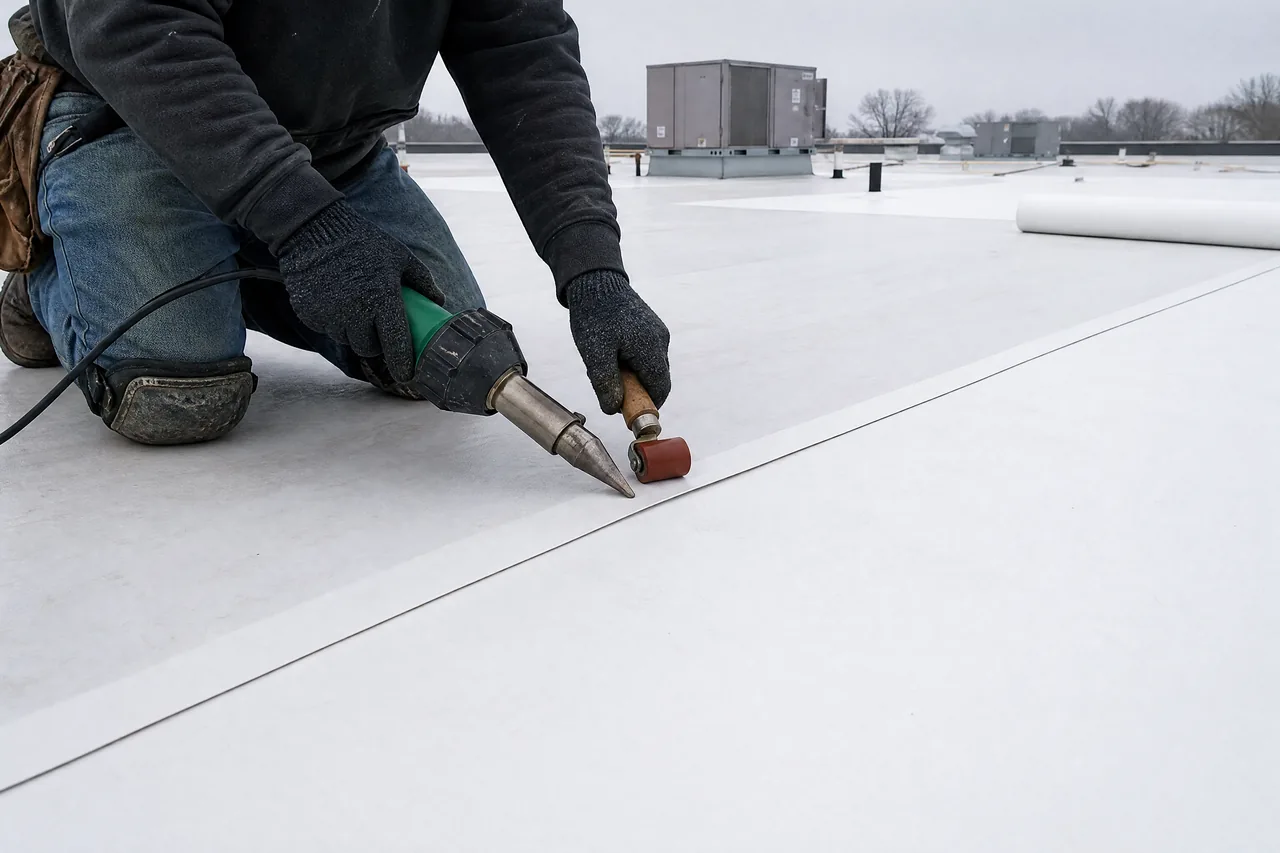
Thermoplastic polyolefin, heat-welded at the seams, usually white. The heat weld is the key difference: it fuses the sheets into one piece rather than bonding them with an adhesive that ages separately from the membrane.
Good: reflective, so it reduces cooling load meaningfully on a flat commercial roof. Seams are the strongest part of the roof rather than the weakest. Looks tidy. Twenty to twenty-five years.
Less good: formulations have changed a lot over twenty years and early TPO had problems, so the long-term data is thinner than EPDM's. It is also welding, which means installer skill is directly load-bearing: a bad weld is a future leak that looks fine on handover day. We probe-test seams before we leave.
Where we use it: most commercial flat roofs, and increasingly on residential low-slope where somebody wants the reflective benefit.
Modified Bitumen, PVC and Coatings
Modified bitumen is asphalt with polymer modifiers, in rolls, either torched down or self-adhered. It is the toughest underfoot of the lot, which makes it the right answer where people walk regularly, and it overlays an existing built-up tar-and-gravel roof happily. Fifteen to twenty years.
PVC is TPO's older, more expensive cousin, and where it earns its money is chemical resistance. If your roof takes grease exhaust from a kitchen, TPO degrades and PVC does not. Restaurant roofs, food processing, anywhere with an oil-bearing exhaust: PVC.
Liquid coatings, silicone or acrylic, go over an existing sound membrane to extend its life and restore reflectivity. Used properly on a dry roof they are excellent value. Used on a roof with saturated insulation they are a waste of money and they hide the problem for a couple of years. We moisture-test before quoting one, every time.
Flat roof at the end of its life? Get a moisture scan before anyone quotes you a coating.
Get My Free Roof Estimate or call (630) 597-1921
Free written estimate · A person calls you back, not a robot · Licensed & insured, verify us before you sign
Questions We Get About This
How do you find a leak in a membrane roof?
Visual inspection of seams, flashings, curbs and drains first, since that is where nearly all of them are. If that does not find it, moisture scanning to map where water has got into the insulation, then work back to the entry point. Leaks travel a long way under a membrane.
Do rubber roofs need maintenance?
Twice a year, and it is mostly clearing drains and scuppers and looking at the seams and flashings. Fifteen minutes of drain clearing in autumn prevents most winter flat roof emergencies in this climate.
Will a rubber roof work in Illinois winters?
Yes. EPDM in particular handles freeze-thaw better than almost anything, which is why it has been on northern roofs for sixty years. The winter risk on a flat roof is drainage and ice, not the membrane.
Can I put solar panels on a TPO roof?
Yes, and ballasted racking is preferable to penetrating racking on membrane. Do the roof first if it is anywhere near end of life, because taking an array off and putting it back later costs more than the roof did.
TPO or EPDM: which should I actually pick?
TPO if the space underneath is air-conditioned and the roof is visible or reasonably large, because the reflectivity and the welded seams both matter at that scale. EPDM if it is a small residential addition, an unconditioned garage or a tight budget, because it is cheaper, the track record is longer and repairs are trivial. On a 300 square foot sunroom over an unheated porch, the reflectivity argument is worth almost nothing and EPDM wins on cost.
How much does a TPO roof cost in Aurora?
Broadly $7.50 to $13.00 per square foot installed on a straightforward roof, which puts a 1,500 square foot commercial flat roof somewhere between $11,000 and $19,500. EPDM typically runs fifteen to twenty-five percent under that. The variables that move it most are insulation, whether the existing roof comes off or stays, tapered insulation for drainage, and how many curbs, drains and penetrations there are to detail around. Roofs with a lot of rooftop equipment cost considerably more than their square footage suggests.
Can you install over my existing flat roof?
Sometimes, and it saves real money, but only if the existing roof is dry and there is only one layer. Building codes generally limit you to two roof systems, and putting a new membrane over wet insulation traps the moisture permanently. We core-sample or moisture-scan before recommending an overlay, because getting this wrong is expensive and invisible for about three years.
Available Across the Fox Valley
Membrane work follows the commercial corridors and the older additions, so it takes us east and along the rail and industrial belt more than anywhere else.
| TPO and EPDM Roofing in West Chicago | Bolingbrook Single-Ply Membrane |
| Rubber Roofing for Naperville | Warrenville EPDM Installation |
| Flat Membrane Roofing in Plainfield | Montgomery TPO Roofing |